Why is white ambergris so highly prized?
In my experience, white ambergris is highly prized because pale pieces have usually weathered longest and developed a more delicate scent, but whiteness alone does not establish quality. It is ambergris described by its pale colour, rather than a separate substance.
I would never identify or grade a find from whiteness alone. I've assessed 4,678 specimens since 2004. Pale wax, pumice and other beach materials can look just as promising, so I look beyond colour.
What does “white ambergris” mean?
“White ambergris” is a practical colour description. It does not mean a piece must be spotless, uniform or bright white: cream areas, grey marks and brown patches can be present.
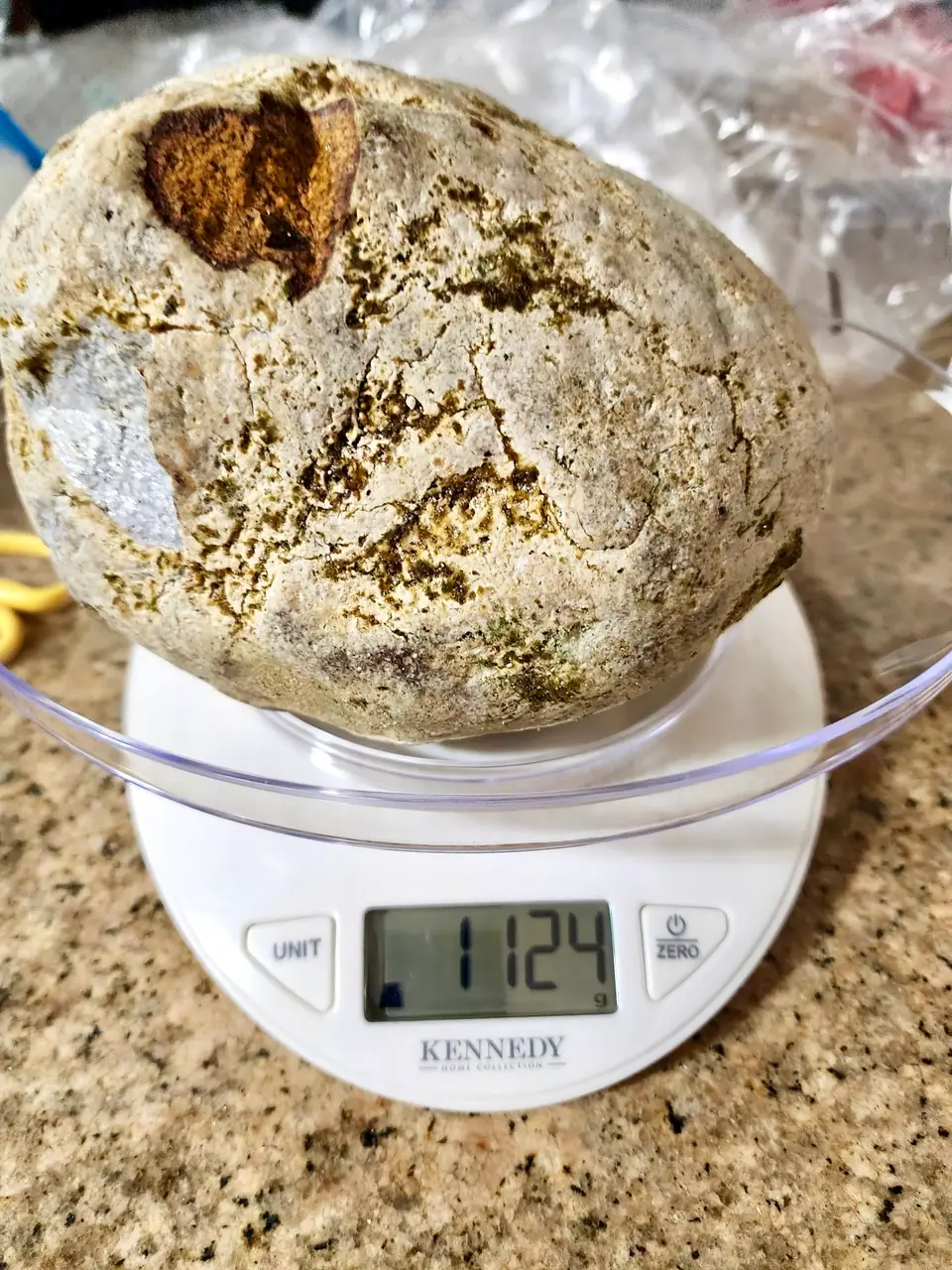
Look at the 1.12 kg specimen above. Much of the outside is pale, with fine cracks and darker markings. A brown patch is visible near the top. That variation is more useful than an idealized image of a spotless white lump.
The scale gives a recorded weight. It does not tell you the specimen's age or scent. I keep those kinds of evidence separate: a photograph can show colour and surface detail while leaving other questions unanswered.
This piece has its own specimen page, and you can compare more views in my ambergris gallery. Look at several examples before deciding whether an unfamiliar find resembles the material.
Why does ambergris become pale?
Exposure to sea and sun can bleach ambergris as its scent becomes more delicate. Clarke (2006) describes these changes in floating ambergris.
The useful lesson is the direction of change, not a calendar. Think of weathered wood: exposure can change the surface, but its colour does not tell you when it entered the water. I read ambergris colour alongside the rest of the piece.
Scientific dating underlines that distinction. In The age of ambergris (2018), researchers analyzed verified jetsam specimens and radiocarbon-dated selected samples. Some had persisted in the environment for about a thousand years. That finding concerns those tested samples. It does not make every pale piece ancient or provide a way to date your find by eye.
A pale surface can be consistent with weathering. It is not an age certificate.
How does white compare with grey and dark ambergris?
White or pale colour is generally associated with more weathering, while darker material is often less weathered. I use these descriptions to organize comparisons, not to assign a final grade from colour alone.
| What you notice | Pale or white | Grey or tan | Dark or black |
|---|---|---|---|
| Colour | Cream, white or pale grey, sometimes marked | Often mixed tones or mottling | Dark skin or brown-black areas |
| General association | More weathered material | A broad range of weathered appearances | Often less weathered material |
| What still needs checking | Identity, scent and condition | Identity, scent and condition | Identity, scent and condition |
This table describes broad tendencies. There is variation within each group, and the outside may differ from the interior. It should not be used as a price chart or as a sequence with a set number of years between colours.
Would you choose the whitest piece from a photograph?
I would first want to know what the material is and what condition it is in. A pale surface cannot communicate scent, internal composition or authenticity. Two equally pale pieces may be very different, and a white lookalike can be convincing in a photograph.
Does white ambergris have to look chalky and clean?
No. The two smaller specimens below show pale surfaces with darker areas, speckles and patches.
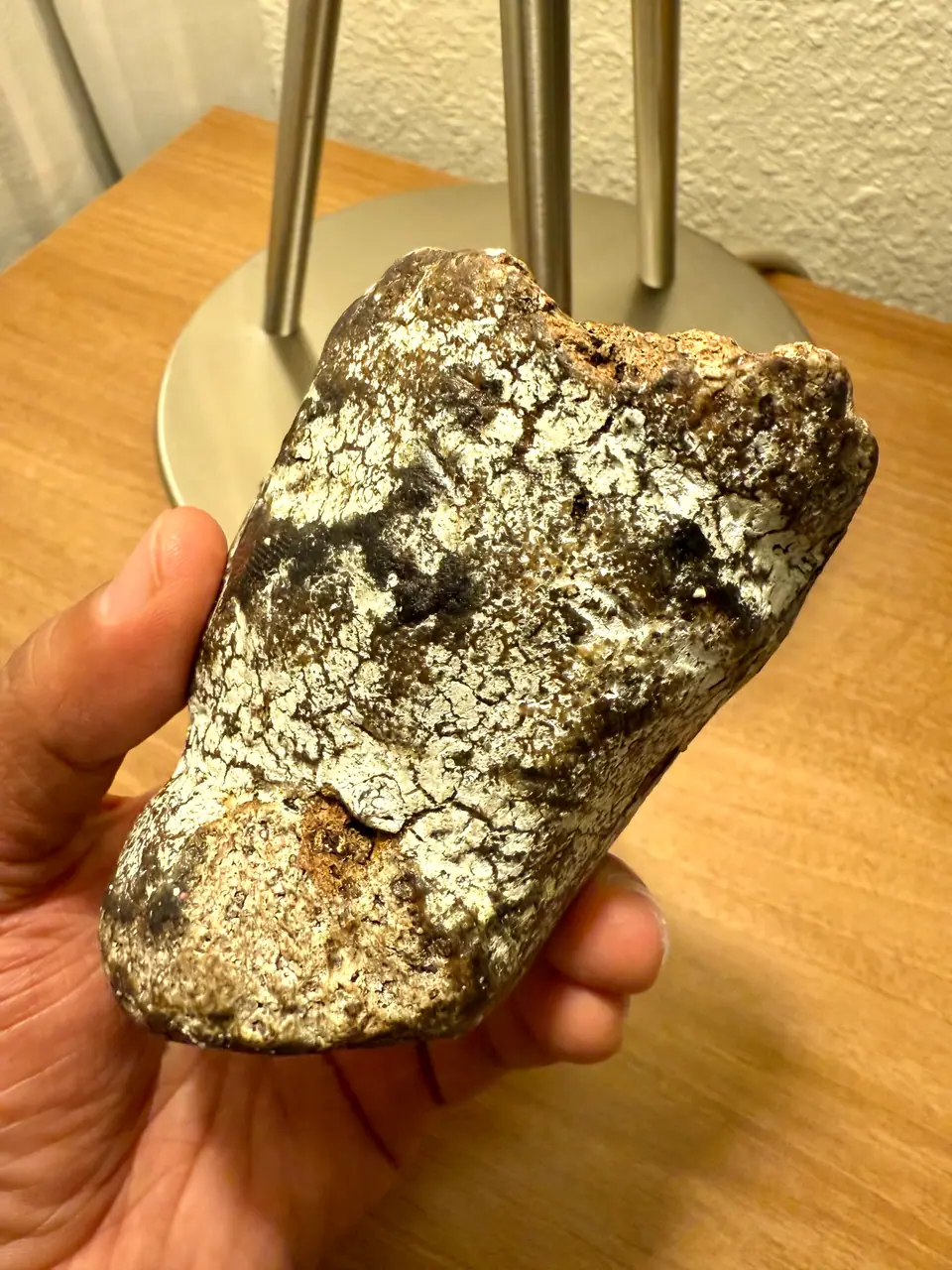
The first has an irregular white crust over much darker areas. Fine cracks break up the pale coating. Describing the whole object simply as “white” would leave out much of what you can see.

The second is smaller and rounder, with dark brown speckles and patches across a pale face. The hand gives scale. It does not establish the specimen's softness or weight.
These are reference examples, not a pattern every genuine piece must copy. I would not identify a find from white patches and cracks alone. Those features need to agree with its other characteristics.
Why are perfumers interested in pale pieces?
Ambergris is used in perfumery for its scent and as a fixative. Weathering can make its smell more delicate, but pale colour alone cannot tell a perfumer how a particular piece will smell.
The chemistry helps explain why scent and colour need separate consideration. Ambrein, a characteristic constituent of ambergris, has little odour itself. Oxidation produces fragrant compounds. Von der Lühe and colleagues (2019) describe this oxidation of ambrein and ambergris's use in perfumery.
That does not give us a chemical formula for “white grade”. A photograph cannot reveal the balance of fragrant compounds, and one pale piece need not smell like another. My ambergris value and grading guide explains how I read colour alongside age at sea, weight, purity and scent.
If you are sourcing material for fragrance work, use the buy ambergris page to explain your requirements. A finder with an unidentified white object should start with identification.
What white lookalikes should you consider?
Pumice and manufactured wax are two lookalikes I would consider with a pale find. Floating alone would not rule them out or confirm ambergris.
Pumice is volcanic material with many gas bubbles. The US Geological Survey's pumice glossary explains that some pumice is light enough to float. An open, bubble-filled, stony surface is useful evidence to photograph. I would not decide from small pits alone.
I also consider paraffin, candle wax and palm-derived fats when assessing a pale, waxy lump. A smooth-looking break or a waxy feel needs context. One familiar feature should never outweigh the whole object.
Use my ambergris identification guide to compare appearance with feel, relative weight and scent. My advice is to keep the find dry. Do not wash, soak or cut it to try to make it resemble a reference photograph.
What photographs help with a pale find?
Send photographs in natural daylight without flash: a whole-object view, another angle and a close-up of the most distinctive texture. Include a coin or ruler for scale.
If a broken face already exists, photograph it without removing more material. Avoid filters or bright edits that turn cream into white or hide darker marks.
I want to see what you found, including its uneven colour. Those details help me assess the find more than the broad label “white”. Photos can support an initial assessment, but a final grade needs physical inspection.
My first-steps guide for a beach find covers storing the piece and what happens next.
Frequently asked questions
White colour alone cannot confirm identity, quality or time at sea. I consider it alongside the other features of a find.
Is white ambergris always the highest grade?
Not automatically. In my experience, white and pale pieces grade highest, but colour does not settle quality on its own: identity, scent and condition still matter. A pale crust can also differ from the material underneath. I would not assign a final grade to an unknown object solely because it looks white in a photograph.
How long does ambergris take to turn white?
There is no reliable colour timetable for an individual piece. Weathering can lighten ambergris, but its surface cannot tell you exactly how long it has been at sea. Published radiocarbon research concerns tested specimens, not a rule for dating white beach finds.
Can real white ambergris have dark patches?
Yes. The photographs in this article show brown patches, speckles and dark areas beneath pale crusts. A uniform white colour is not required. Equally, I would not treat mixed colours as proof of authenticity.
Is a white lump that floats likely to be ambergris?
Floating alone is not enough to judge. Pumice can float too, and I also consider waxes and fats when assessing a pale find. Keep the object dry and compare several features. I recommend sending clear photographs rather than repeatedly putting it in water.
If you have a pale find, send me photos for a free assessment. You don't need to know what it is or what grade it might be. That's my job. I review every photo myself and reply within 24 hours. There's no obligation, and Ambergris Canada also buys ambergris where the law allows.