What does ambergris look like? A walk through real photos
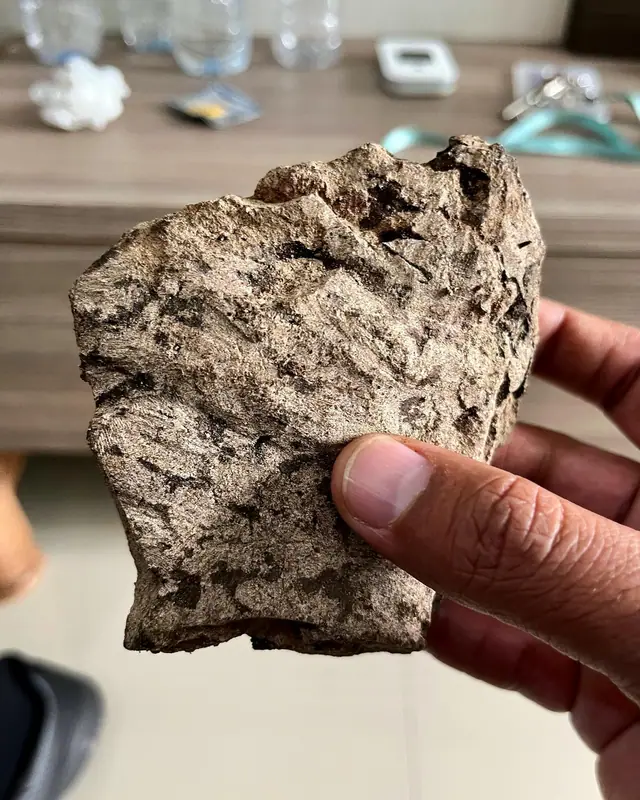
Ambergris can look black, brown, grey, tan or white, with a dull surface, irregular shape and sometimes rings, swirls or a cracked crust. One piece may show several colours.
I've assessed 4,678 specimens since 2004. Here, I walk you through photos of genuine specimens so you can compare your find without treating a visual match as proof.
Why can two genuine pieces look so different?
Two pieces can look different because one shows its outer skin and the other a broken face. Weathering can also change the colour. A rounded lump, an angular fragment and a broad slab can all be genuine.
Clarke (2006) describes how floating ambergris can lighten in the sea and sun and develop a delicate scent. That broad pattern helps me describe it. It does not let me place every specimen on a neat timeline from fresh black to ancient white.
These photographs are comparisons, not time-lapse frames. Nothing in the images establishes how many years each piece spent at sea. Start with what you can see: where the dark skin ends, how a pattern crosses the surface and what an existing break reveals.
What does a dark outer skin look like?
A dark outer skin can contrast with pale crusty patches and a brown-tan interior. In this 0.66 kg group, the largest fragment shows all three.

Smaller flakes lie in front of the largest fragment on the scale. Look at the contrast between the outside and the existing breaks.
This is not a uniformly black object. A dark surface does not tell you what the interior looks like or prove that the piece is newly formed. I use “dark-skinned” to describe the visible skin, without assigning an age from the photograph.
If your find has an existing broken edge, photograph it. Leave an intact piece intact. You do not need to break your find to compare it with this specimen.
What do rings on grey ambergris look like?
On this 11.46 kg specimen, fine curved lines follow darker rounded patches within a pale grey and white face. There are several sets of rings rather than one tidy bullseye.

The face is broad and uneven, with small cracks crossing the surface. Follow the curved lines around each darker patch to see how the patterns vary across the piece.
A genuine specimen can have these patterns without every genuine specimen having them. The same caution applies in reverse: rings in an unidentified object do not establish ambergris. I compare the whole surface before giving one striking feature too much weight.
How are swirls different from rings?
In these photographs, the rings form repeated contours around rounded areas, while the swirls are looser, less regular curves. Neither pattern is a required feature of ambergris.

On this rounded 4.68 kg piece, dark curved marks run through a grey-brown surface. Pale patches break up the colour, and some edges appear flaky. This close view shows texture more clearly than the overall outline.
Compare the darker curves with the ringed piece above. Look at how they cross the surface, rather than expecting the patterns to match.
You may also notice that this specimen, described as “pale grey”, looks warmer or browner in the photograph. I treat a colour name as a useful description, not a substitute for examining the material.
What does the tan inside of ambergris look like?
In piece H, the exposed interior is tan and uneven, with curved layers, small cavities and darker material near the edge. The outer rim includes both dark skin and a pale crust.

This is another view of the same piece and fragments introduced in the first photograph. It is not a separate tan specimen or a later stage of ageing. The contrast shows why a piece can look like two different materials when turned over.
“Biscuit-like” can help describe a dry, crumbly-looking face, but it is only a visual analogy. The photograph cannot tell you how easily this material breaks, how it feels or whether your own similar-looking object is genuine.
Look again: are the dark fragments and tan cross-section different specimens?
No. They are different views of piece H, recorded as a 0.66 kg piece and its fragments. The colour contrast shows why the outer skin and an exposed interior must be considered separately. It does not show a timed change from dark to tan.
What does a squid beak in ambergris look like?
The squid beak in this photo looks like a small, dark point near the centre of the grey-white piece.
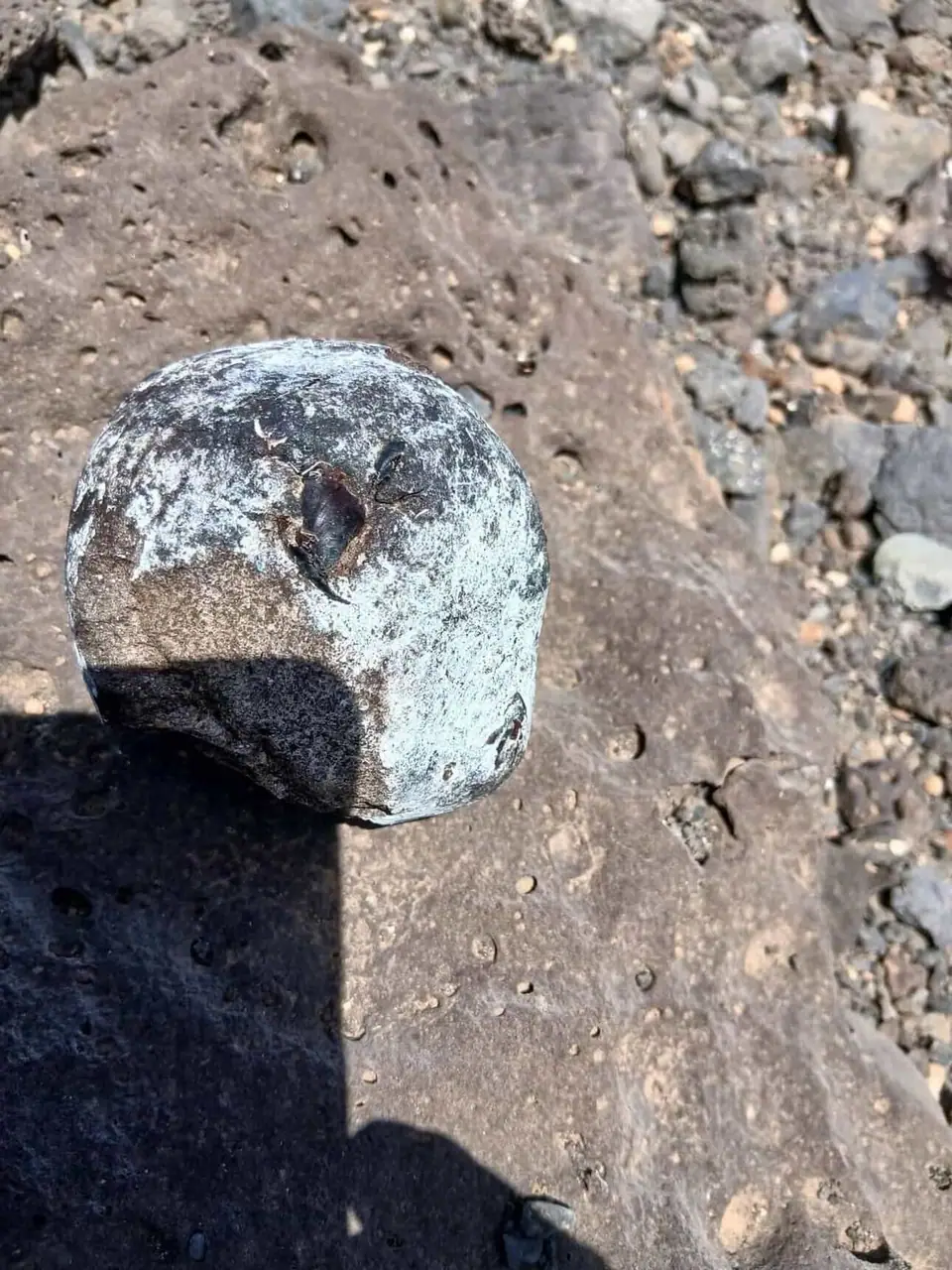
Clarke notes that fragments of squid beaks can sometimes be seen between layers of ambergris. In a different specimen, Rowland et al. (2024) found chemical evidence consistent with the presence of beaks. That does not mean every dark fleck in a find is a beak.
If you see a dark fleck, could it be the edge of a shell or a sliver of wood? I would not identify an inclusion from one small photograph or rule out ambergris simply because no beak is visible. Photograph any exposed inclusion clearly, but do not dig into a find looking for one.
What should you compare with your own find?
Compare the whole shape, surface colours, patterns and any existing broken faces. Use those details to describe your find, rather than treating one matching feature as confirmation.
| Photo feature | Useful observation | What it cannot establish |
|---|---|---|
| Dark skin, tan face | Outside and inside differ | Exact freshness or age |
| Concentric rings | Curved patterns cross the surface | Certain identity |
| Dark swirls | Pattern varies across a rounded piece | A compulsory ambergris feature |
| Pale crust | Note the colour on an existing break | Grade from colour alone |
| Visible inclusion | A close-up may help assessment | Identity from one dark mark |
Keep the image comparison separate from the physical checks. My ambergris identification guide covers feel, relative weight, scent and careful handling. The ambergris gallery provides more known specimens and alternative angles.
Frequently asked questions
Ambergris can have several colours and surface features, but appearance alone cannot confirm a find. These answers explain how I use photographs in a first assessment.
Is ambergris always white?
No. Genuine ambergris can be dark brown or black, grey, tan, cream or white. A single piece can combine several colours. The specimens above show why I describe a pale crust, dark skin and tan interior separately rather than reduce a piece to one colour.
Does ambergris look like a rock?
It can resemble a rounded stone at first glance, particularly in a photograph. That is one reason I also consider relative weight, feel, scent and surface detail. A rock-like outline alone does not tell me whether a find is ambergris or an ordinary stone.
Can ambergris have holes and cracks?
Yes. Existing cracks, cavities and irregular edges are visible in the specimens above. Their size and pattern vary. I use them to describe a piece, but I do not identify ambergris from a hole or crack alone.
Can you identify ambergris from a photo?
Photos let me make a first assessment of visible features, but confirmation requires physical inspection. They cannot convey scent, feel or chemical composition.
Photograph the whole piece in daylight beside a ruler, then take a close-up of the clearest surface detail. I reply within 24 hours.
Keep your find dry and send me photos for a free assessment. You can also read how the assessment works before getting in touch.